


Top 5 ERP Software of 2025: Choosing the Right System for Your Future Running a business in 2025 is more demanding than ever. Customers expect lightning-fast service, industries evolve overnight, and organizations must keep every department—from sales to finance to operations—working in sync. If your business is still juggling spreadsheets or disconnected tools, you may be spending more time fixing inefficiencies than focusing on growth. That’s where ERP (Enterprise Resource Planning) software comes in. Think of ERP as your company’s central nervous system—a single integrated platform that connects every part of your business into one seamless flow. But with countless ERP solutions available, which one is the best fit for you? Here are the Top 5 ERP Software of 2025 that businesses worldwide are relying on to streamline operations and drive sustainable growth. 1. Odoo ERP – The Flexible Growth Partner Odoo has quickly gained global popularity, especially among SMEs and growing companies, because of its modular design and affordability. Why it stands out: Businesses only pay for the modules they need—whether it’s CRM, accounting, HR, inventory, or production. Being open-source-erp, Odoo is customizable and scalable, making it a perfect choice for organizations that want flexibility without overspending. Ideal for: Small to medium businesses, large organizations, and fast-scaling companies seeking flexibility and affordability. Considerations: While Odoo services provides excellent flexibility, some advanced customizations may require expert implementation and ongoing technical support to unlock its full potential. 2. SAP S/4HANA – The Enterprise Giant SAP has long been a dominant force in ERP, and its S/4HANA platform continues to lead for global enterprises. Why it stands out: Real-time insights, advanced analytics, and strong compliance capabilities across multiple regions. Best for: Large multinational corporations with highly complex operations. Considerations: Implementation can be time-intensive and costly, but the payoff in functionality is unmatched for large-scale enterprises. 3. Oracle NetSuite – The Cloud Innovator Oracle NetSuite remains one of the strongest cloud-based ERP solutions, trusted by fast-growing companies across industries. Why it stands out: 100% cloud-native with real-time dashboards, scalability, and seamless global access. Best for: Mid-sized and global businesses seeking rapid growth and strong financial management. Considerations: Subscription costs can scale up as the business expands, making budgeting a key factor. 4. Microsoft Dynamics 365 – The Familiar Choice Microsoft Dynamics 365 is the go-to solution for companies already operating within the Microsoft ecosystem. Why it stands out: Deep integration with Office 365, Teams, and Azure, plus AI-driven insights for smarter decision-making. Best for: Organizations that rely heavily on Microsoft tools and want a smooth, connected experience. Considerations: Licensing models can be complex, and customization often requires specialized expertise. 5. Infor CloudSuite – The Industry Specialist Infor sets itself apart by focusing on industry-specific ERP solutions. Why it stands out: Pre-built functionality for industries like manufacturing, healthcare, and automotive, along with robust supply chain tools. Best for: Companies in niche sectors requiring tailored, industry-focused ERP capabilities. Considerations: May not be as flexible for organizations outside of its specialized industries. Why Partner with Otibro Techni Private Limited? Choosing the right ERP is just the beginning. The real challenge lies in implementation, customization, and ongoing support. That’s where Banibro IT Solutions makes the difference. With over a decade of expertise in Odoo ERP, we help businesses like yours: Implement ERP systems tailored to your processes Customize modules to align with your unique goals Seamlessly integrate ERP with existing tools Train your team for smooth adoption Provide reliable post-implementation support At Banibro, we don’t just deliver ERP—we transform it into a growth engine for your business. The Future of ERP Software ERP systems in 2025 are no longer just about managing daily operations. With the rise of AI, automation, and Industry 4.0, they are becoming smarter, predictive, and deeply integrated with IoT. Businesses that embrace ERP today will be the ones ready for the challenges of tomorrow. Final Thoughts The Top 5 ERP Software of 2025—Odoo, SAP S/4HANA, Oracle NetSuite, Microsoft Dynamics 365, and Infor CloudSuite—offer unique strengths depending on your needs. The right choice can unify your operations, drive smarter decisions, and unlock growth opportunities. If you’re ready to future-proof your business,Otibro Techni Private Limited is here to guide your ERP journey—from strategy to execution. Let us help you turn ERP into your competitive edge. FAQ Which ERP software is best for small businesses in 2025? Odoo ERP is often the top choice for SMEs thanks to its modular design, affordability, and scalability. It allows businesses to start small and expand features as they grow. How do I know which ERP system is right for my company? The best ERP depends on your size, industry, and growth goals. For example, SAP S/4HANA suits global enterprises, while Odoo is perfect for flexible and cost-conscious businesses. A consultation with an ERP expert like Banibro IT Solutions helps narrow the right fit. Is cloud-based ERP better than on-premise? Cloud ERP solutions like Oracle NetSuite and Microsoft Dynamics 365 provide scalability, mobility, and lower upfront costs. On-premise ERP may be better for businesses requiring tighter data control. Many companies now prefer hybrid models for the best of both worlds. Can ERP systems integrate with my existing tools? Yes. Modern ERP platforms are designed to integrate seamlessly with tools such as CRM, eCommerce platforms, accounting software, and even IoT devices. At Otibro, we specialize in customizing integrations for smoother workflows. Why should I choose ,Otibro Techni Private Limited for ERP implementation? We bring over a decade of expertise in Odoo ERP, offering end-to-end services—implementation, customization, training, integration, and support. Unlike generic vendors, we focus on tailoring ERP into a true growth engine for your business. What is the future of ERP software in 2025 and beyond? ERP systems are becoming more intelligent with AI, predictive analytics, and Industry 4.0 integration. Future-ready ERP solutions will not only streamline operations but also provide actionable insights to stay competitive in fast-changing industries.
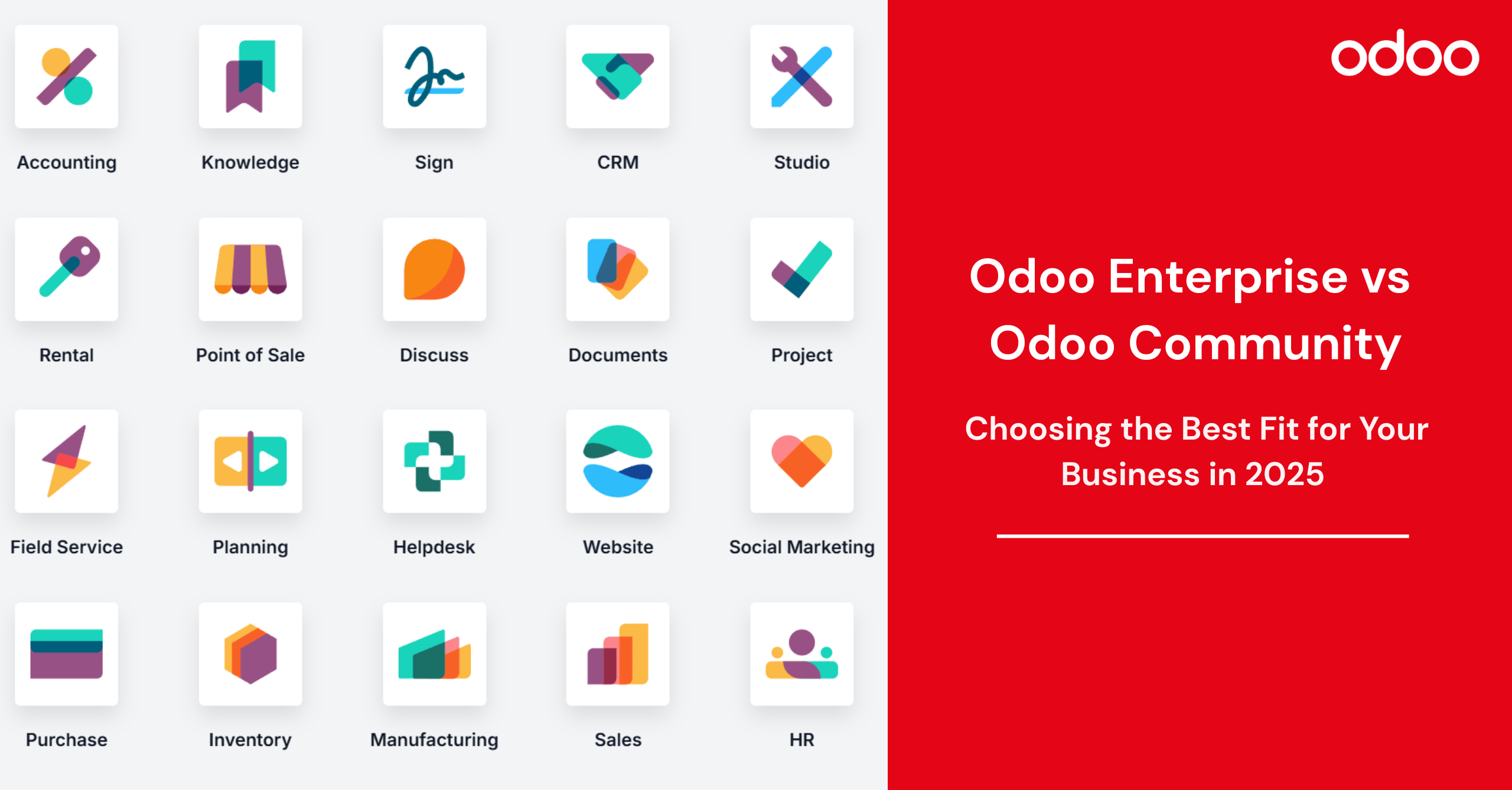
Odoo Community vs Enterprise Choosing the Best Fit for Your Business in 2025 Introduction In 2025, businesses face unprecedented competition, where agility, operational efficiency, and digital transformation are no longer optional—they are imperative. Enterprise Resource Planning (ERP) platforms have evolved into the backbone of organizational coherence, binding disparate processes into a unified framework. Among the frontrunners, Odoo emerges as a versatile solution, offering two distinct editions: Odoo Community vs Enterprise. Choosing between these two is not merely a technical decision but a strategic commitment that can shape the trajectory of a business. Understanding Odoo Community Edition Odoo Community Edition is the open-source foundation of the Odoo ecosystem, crafted for those seeking a cost-effective yet robust ERP solution. It provides a suite of core applications covering essential operations—sales, inventory, CRM, and accounting—without licensing fees. Its greatest strength lies in adaptability. With full access to the source code, businesses can tailor modules extensively, aligning the software to nuanced operational demands. This flexibility appeals to startups, small enterprises, and technically adept teams capable of managing in-house customizations. However, the absence of certain advanced functionalities and official support can pose constraints, especially for organizations lacking deep technical expertise. Understanding Odoo Enterprise Edition Odoo Enterprise Edition elevates the Community framework with an arsenal of advanced features, polished user interfaces, and exclusive modules designed to scale complex operations. It combines the versatility of open-source roots with the assurance of premium-grade capabilities. From sophisticated manufacturing automation to advanced accounting, marketing automation, and mobile app integration, the Enterprise Edition is engineered for performance in high-demand environments. Beyond features, it offers dedicated support, regular upgrades, and enhanced security protocols—crucial elements for enterprises where downtime or inefficiency translates directly into financial loss. Detailed Feature Comparison: Odoo Community vs Odoo Enterprise Category Feature Odoo Community Odoo Enterprise General License Open-source Proprietary (Paid) Hosting Options Self-hosted Odoo Online / Odoo.sh / On-premise Upgrades Manual Automated by Odoo Mobile App Support ❌ ✅ Odoo Studio (App Builder) ❌ ✅ User Interface UI Customization & Themes Basic Enhanced (Responsive, Mobile-ready) Barcode Scanner Interface ❌ ✅ Sales & CRM CRM Core Features ✅ ✅ Digital Signatures (eSign) ❌ ✅ VoIP Integration ❌ ✅ Subscription Management ❌ ✅ Sales Coupons / Promotions ❌ ✅ Online Payment Integrations Limited ✅ Accounting & Finance Invoicing Basic Full Accounting Suite Budgeting, Asset Management ❌ ✅ Bank Reconciliation ❌ ✅ Localized Tax Reports (Country-wise) ❌ ✅ Consolidated Journals & Advanced Reports ❌ ✅ Inventory & MRP Inventory Management ✅ ✅ Barcode Integration ❌ ✅ Shipping Connectors (UPS, DHL, FedEx) ❌ ✅ Multi-Company / Multi-Warehouse Limited ✅ Manufacturing Resource Planning (MRP) ✅ ✅ + Advanced MRP Tools PLM (Product Lifecycle Management) ❌ ✅ Maintenance Management ❌ ✅ Quality Checks & Control ❌ ✅ HR & Payroll Employee Directory ✅ ✅ Payroll ❌ ✅ Appraisal & Recruitment ❌ ✅ Timesheet / Attendance ❌ ✅ Fleet Management ❌ ✅ Project Management Task Planning ✅ ✅ Forecasting, Gantt Chart View ❌ ✅ Project Profitability Reports ❌ ✅ Website & eCommerce Website Builder ✅ (Basic) ✅ (Advanced) eCommerce Features ❌ ✅ Customer Portal ❌ ✅ Multi-language / Currency Support Limited ✅ Marketing Email Marketing ✅ ✅ Marketing Automation ❌ ✅ SMS Marketing ❌ ✅ Events, Survey, Live Chat ❌ ✅ Services & Support Helpdesk ❌ ✅ Field Service Management ❌ ✅ Knowledge Base / eLearning ❌ ✅ Official Odoo Support ❌ ✅ Security & Access LDAP / OAuth Login ❌ ✅ Access Rights Management Basic Enhanced Audit Logs ❌ ✅ Factors to Consider Before Choosing The decision between Odoo Community and Enterprise hinges on several critical factors: Budgetary Scope – Community eliminates licensing costs, while Enterprise requires subscription fees in exchange for extended capabilities and support. Operational Complexity – Businesses with intricate, multi-departmental processes often benefit from Enterprise’s advanced modules. Technical Resources – Community demands a self-reliant technical team for maintenance, whereas Enterprise reduces this dependency through vendor-backed support. Scalability – If rapid expansion or multi-location management is on the horizon, Enterprise provides the infrastructure for seamless scaling. Which Edition is Right for You in 2025 In 2025, the selection must be aligned with long-term vision, not just immediate functionality. For lean startups or organizations in emerging markets, Odoo Community offers a prudent entry point with unparalleled customization potential. For mature businesses, high-growth enterprises, or those operating in compliance-heavy industries, Odoo Enterprise delivers the resilience, security, and sophistication needed to maintain competitive dominance. The optimal choice is the one that not only meets present operational needs but also anticipates future challenges. In the accelerating pace of digital commerce and global trade, foresight in technology adoption will distinguish leaders from followers. Conclusion The debate between Odoo Community and Enterprise is less about superiority and more about suitability. Each edition serves a distinct archetype of business, shaped by size, ambition, and available resources. In the evolving business climate of 2025, the right choice will be the one that harmonizes technological capability with strategic intent, enabling enterprises to not only survive but flourish. Ready to choose the right Odoo edition for your business? At Otibro Techni pvt. ltd, an Odoo implementation partner, we specialize in helping businesses seamlessly implement and customize Odoo—whether you opt for the flexibility of Community or the advanced power of Enterprise. Our team ensures your ERP is perfectly aligned with your goals, industry needs, and growth plans.

In today’s rapidly evolving business landscape, Odoo ERP (Enterprise Resource Planning) is vital in enabling organizations to streamline their operations, enhance efficiency, and drive sustainable growth. In this blog let’s explore what is odoo, why to use Odoo ERP, Industries Using Odoo Erp, and How to find the odoo Implementation Partner What is Odoo Odoo is a suite of open-source business apps that cover all your company needs: CRM, eCommerce, accounting, inventory, point of sale, project management, etc.Source:Odoo To make it more understandable, Odoo is a comprehensive suite of business management software that provides a range of integrated applications to help companies streamline their operations. It is an open-source ERP (Enterprise Resource Planning) platform that encompasses various modules, including sales, CRM, accounting, inventory management, project management, manufacturing, e-commerce, and more. Odoo offers flexibility and scalability, making it suitable for businesses of all sizes and industries. It provides a unified and centralised platform for managing different aspects of a company’s operations, allowing for efficient data management, collaboration, and decision-making. With its modular approach, businesses can customise and tailor Odoo to meet their specific needs, adding or removing modules as required. Odoo empowers businesses to optimize their operations, enhance productivity, improve customer relationships, and drive growth by providing a comprehensive and flexible ERP solution. Benefits of Odoo ERP There are several compelling reasons why businesses can greatly benefit from implementing Odoo ERP 1. Streamlined Operations Odoo ERP integrates various business functions and departments, such as sales, CRM, accounting, inventory, project management, and manufacturing, into a centralized platform. This integration eliminates data silos, reduces manual processes, and enhances collaboration, resulting in streamlined operations and improved efficiency. 2. Improved Productivity: Odoo automates repetitive tasks and workflows, reducing the time and effort spent on manual data entry and administrative tasks. This automation allows employees to focus on more value-added activities, increasing overall productivity and maximizing resource utilization. 3. Enhanced Decision-making: With real-time access to accurate and consolidated data, decision-makers can make informed and timely decisions. Odoo provides powerful reporting and analytics tools that enable businesses to gain insights into key performance indicators, sales trends, inventory levels, and financial data, facilitating data-driven decision-making. 4. Scalability and Flexibility: Odoo ERP is highly scalable, making it suitable for businesses of all sizes, from small startups to large enterprises. As companies grow and evolve, they can easily add or customize modules within Odoo to meet their changing requirements. This scalability and flexibility ensure that the ERP system can adapt and support business growth effectively 5. Customer Relationship Management: Odoo’s CRM module enables businesses to manage their customer relationships effectively. It provides a comprehensive view of customer interactions, sales pipelines, and customer support activities. This allows businesses to improve customer satisfaction, track leads, manage sales processes, and nurture long-term customer relationships. 6. Supply Chain Optimization: Odoo ERP includes modules for inventory management, procurement, and logistics, enabling businesses to optimize their supply chain processes. From managing suppliers and tracking inventory levels to streamlining procurement and fulfillment operations, Odoo helps businesses achieve greater control and efficiency throughout the supply chain. 7. E-commerce Integration: In the digital age, integrating e-commerce capabilities is crucial for many businesses. Odoo offers e-commerce modules that allow businesses to create and manage their online stores seamlessly. This integration ensures a consistent and synchronized flow of data between the ERP system and the e-commerce platform, simplifying order processing, inventory management, and customer data synchronization. 8. Cost Savings: By consolidating multiple business functions into a single ERP system, businesses can reduce the costs associated with maintaining separate software applications and managing data integration between them. Odoo’s open-source nature also eliminates licensing fees, making it a cost-effective solution compared to proprietary ERP systems Industries Using Odoo ERP A wide range of industries uses Odoo ERP due to its flexibility and customizable nature. Some of the industries that commonly utilize Odoo ERP include: 1. Manufacturing 3. Service-based industries 4. Distribution and Logistics 5. Construction and Engineering 6. Healthcare 7. Education 8. Nonprofit Organizations Stay tuned upcoming blog posts will provide an in-depth exploration of the tangible benefits that Odoo ERP brings to these industries. We will delve into the ways in which Odoo ERP positively impacts these sectors, offering valuable insights into the specific advantages businesses can gain from implementing Odoo ERP in their operations. In summary, Odoo ERP provides businesses with the tools and capabilities needed to streamline operations, improve productivity, make informed decisions, optimise the supply chain, enhance customer relationships, If you are seeking a reliable Odoo implementation partner, you have come to the right place. We are proud to be one of the trusted Odoo implementation partners based in India.

Know more about Odoo17: Odoo releases its new version every year during the month of October with exciting and advanced features. Both community and enterprise users can avail the new features of Odoo. Odoo16 was released on October 2022. Now the expectation begins for Odoo17 since the last version of Odoo had many major updates and improvements in UI as well as performance. So, users are excited to know about the upcoming features of Odoo 17. This blog will describe the expected and confirmed features of Odoo17. About Odoo: Odoo has become popular in the recent times due to its competitive pricing and features. Odoo is an integrated ERP platform with almost all the features needed for SMEs. Odoo is used in many industries like retail, restaurant, construction,manufacturing ,accounting,etc., Odoo has 2 versions enterprise and community where enterprise will have more features compared to community. Depends on the customer need, it can be decided between community and enterprise. Expected Features of Odoo17: The list of features we can expect in Odoo17 is covered here. 1.Enhanced UI: As per the latest Odoo update, the image below will give an insight on the user interface and experience. This is the expectation reality may differ in the final release. But Odoo will come up with an exciting UI for sure. 2. Advanced Search: Odoo have an extended search functionality already but they are still extending their search mechanism in different aspect. Now Odoo come up with an advanced search filter where user can easily define the search filter to search records. This option is definitely going to be an advantage for business with more data load. 3. PWA: In the past several Odoo versions, Odoo is concentrating more towards keyboard shortcuts to enhance user experience. So Odoo PWA might be updated with several shortcuts which allows easy access of odoo apps. Odoo provides access to select records using keyboard and easily unselect it through keys. 4. Freeze header Odoo doesn’t have header freeze option in earlier versions so when we scroll down header will be hidden. Now they come up with the option to freeze header even when we scroll through records. 5. Product Catalog Odoo may allow to select products in sale order from Kanban view like showing complete product catalog so we can select the required product and add it in order line. So , user can easily select the product without searching much. 6. Sign Reminder Odoo reminds you about the documents you need to sign or you need to get it signed. No need to keep all reminders in mind let odoo do it for you so you can concentrate on enhancing the productivity of your business. In conclusion, To conclude, Odoo is always coming up with surprises in its every version. We have got many updates that allows businesses not to worry much about internal operations which odoo can take care of. In the same way , we can expect lot more advanced and exciting features in Odoo17 . To know more about Odoo updates, please follow our blogs, we will keep you posted about Odoo. And you can also ask your queries to us through chat. Feel free to contact us!

Artificial Intelligence (AI) has been revolutionizing various industries, including web development. AI has made it possible to create more dynamic, personalized, and efficient websites that can enhance user experience and increase engagement. In this blog post, we’ll explore the influence of AI on web development. Customized User Experience: With AI, web developers can now create websites that offer customized user experiences based on individual user behavior. AI algorithms can analyze user data to provide personalized content, product recommendations, and search results, making the user feel more valued and engaged. Personalized web experiences are more likely to keep users on the site for longer periods, reducing bounce rates and increasing conversions. Intelligent Chatbots:: Intelligent chatbots powered by AI have become an integral part of modern websites. Chatbots can provide 24/7 customer support, answer user queries, and provide product recommendations. With machine learning algorithms, chatbots can learn from user interactions to provide more accurate and relevant responses over time. Predictive Analytics: Predictive analytics has become an essential tool for web developers to identify user patterns and trends. AI-powered predictive analytics algorithms can analyze user data to predict user behavior, such as what products they are likely to purchase, what pages they are likely to visit, and how long they are likely to stay on the site. This information can be used to optimize the website and improve the user experience. Automated Web Development: AI algorithms can now automate various web development tasks, such as generating code, testing, and deployment. With AI, web developers can reduce development time and increase productivity, allowing them to focus on more complex tasks.
 Corporate Office:
 UAE:
UAE: USA:
USA: Support